


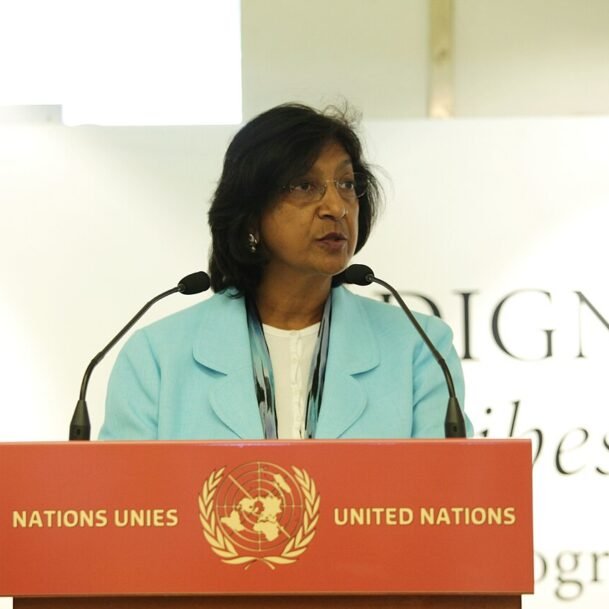
When the Norwegian Nobel Committee announced the 2026 Peace Prize on 9 October, it had not yet reached the winner. Navi Pillay, 85, is a South African judge. The committee credited her “efforts to promote peace and international law,” according to the United Nations. Committee chair Jørgen Watne Frydnes said her work “is a source of hope and inspiration to all those who seek to bring about a more peaceful world,” ITV News reported. The prize is worth 12 million Swedish kronor, about $1.2 million.
The citation names international law as the work. That is an odd thing to win a peace prize for. It is also a useful thing to study.
The ruling where Navi Pillay moved a definition
On 2 September 1998, three judges sat in Arusha, Tanzania, and read out a verdict. Jean-Paul Akayesu, a former mayor of the town of Taba in Rwanda, was found guilty on nine of 15 counts. The United Nations press office called it the first genocide conviction by an international court. The counts covered genocide, direct and public incitement to genocide, and crimes against humanity. The judges were unanimous, and they acquitted him on the other six counts.
The bench was Laity Kama of Senegal, Lennart Aspegren of Sweden and Navanethem Pillay of South Africa. The UN press release on the verdict says the chamber held that rape and sexual violence can be genocide. That applies when they are committed with intent to destroy a targeted group. The chamber called sexual violence an integral part of the destruction of the Tutsi group. It wrote that “the rape of Tutsi women was systematic and was perpetrated against all Tutsi women and solely against them.”
South African History Online records Pillay’s own summary: “From time immemorial, rape has been regarded as spoils of war. Now it will be considered a war crime.”
Look at how the change happened. Three judges tested a legal definition against evidence. Then they said what the evidence meant. Definitions move this way, in a room with a case file and a deadline.
The unglamorous start of a global career
Thirty-one years before Arusha, in 1967, Navi Pillay opened her own law practice in Natal. The UN calls her the first woman to open a practice in Natal Province. It says she defended anti-apartheid activists, including Nelson Mandela. ThePrint reports that she was born in Durban in 1941 into a family of Indian Tamil heritage and grew up under apartheid.
The early cases of Navi Pillay rarely made a highlight reel. In 1971 she represented ten members of the Non-European Unity Movement, who were charged under the Terrorism Act. By 1973, South African History Online says, she had won political prisoners the right to see legal counsel.

Nobody tweets about access to counsel. It does not trend. Yet a prisoner who can see a lawyer stands in a different legal position from one who cannot. Her later work leans on that kind of dull, structural win.
The credentials came alongside the casework. She earned a doctorate in law at Harvard in 1988. In 1995, the UN says, she became the first Black woman appointed to South Africa’s High Court. Business Today reports that Nelson Mandela appointed her as an acting judge.
That same year she joined the International Criminal Tribunal for Rwanda, which sat in Arusha. She served there for eight years, four of them as president. From 2003 to 2008 she was a judge at the International Criminal Court. Then she became UN High Commissioner for Human Rights, a post she held from 2008 to 2014. Later she served as an ad hoc judge at the International Court of Justice in The Gambia v. Myanmar.
A prize with a fight attached
This prize arrives with an argument already running. In September 2025, the UN commission of inquiry she chaired concluded that Israel had committed genocide in Gaza. The commission also said senior Israeli officials had incited it. Israel rejected those findings. ThePrint notes that these were findings of a commission of inquiry, not a judgment from a court.
UN Secretary-General António Guterres called the prize “a tribute to all those working to uphold and defend international law, the rule of law and human rights.” Of Navi Pillay herself he said she “has shown that the force of law must prevail over the law of force.”
Readers will land in different places on the commission’s conclusions. The record supports a narrower point that holds either way. Navi Pillay has spent nearly six decades in the seats where findings get written and tested. The fights follow her because those seats matter.

What Navi Pillay can teach globally minded professionals
TIME AFRICA reads stories like this through AfroNouveau, a cultural positioning framework for globally minded Africans and people of African descent. Through that lens, two practical points stand out. For more on treating your career as an asset, read Your Personal Brand Is a Business.

First, tie your credentials to a local record. The Harvard doctorate sits in her biography next to courtrooms in Natal. The international posts came after the local work. A degree is a promise. A track record is proof. If you build a career across borders, keep the paper trail from home. Nobody can question it.
Second, pick the argument other people skip. The Akayesu holding turned on a definition: what counts as genocide, and whether rape belongs inside it. Most people scroll past the definitions section of a document. That section decided this case. Whether you work in compliance, contracts or product policy, power sits there. So when the next draft lands in your inbox, read the definitions first. Then ask who wrote them, and who gets to change them.
Public service built on a long record is a pattern, and you can see another version of it in our profile of Governor Wes Moore.
Navi Pillay and the quiet rooms where precedent gets built
Prizes get announced on a single morning. Precedent gets built over decades, in rooms with no cameras. Navi Pillay’s route ran from a Natal law practice to the International Criminal Court and on to the top human rights job at the UN. The prize now sits at the end of it. How many African lawyers and policy writers sit in those quiet rooms this week? And are the rest of us building the record that earns a chair?
All stats are verified and cited.