


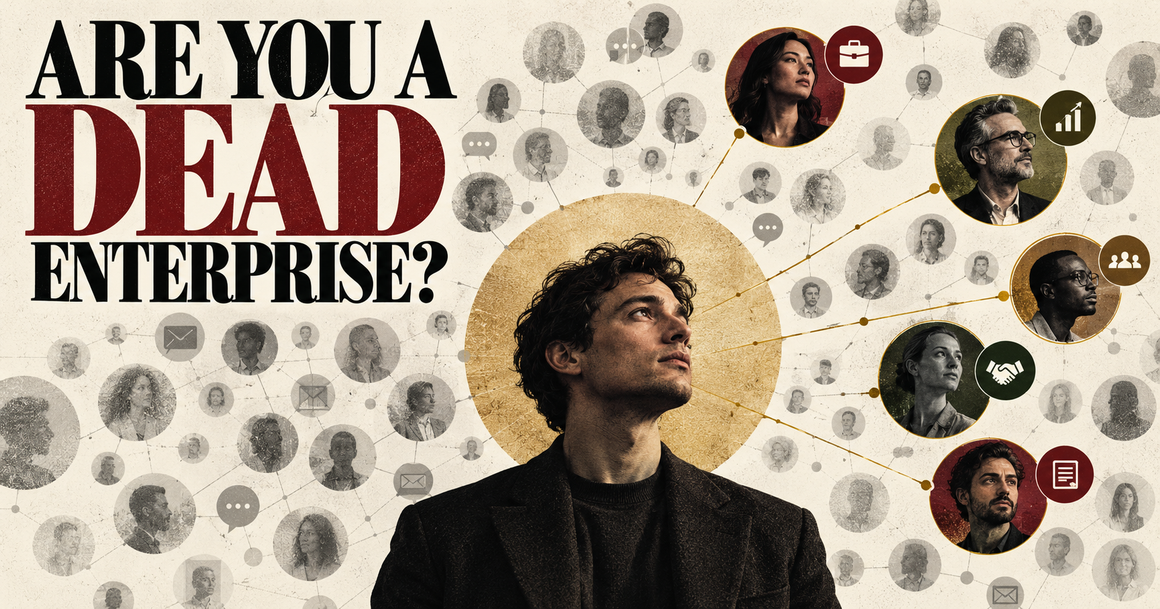
Our people built networks as infrastructure long before anyone put a follower count on one. So why are so many of us holding thousands of contacts and calling nobody?
Atlanta, Lagos, London, Accra, Houston, Johannesburg. The diaspora map is a network map, and it is gorgeous. WhatsApp groups with 900 members. Conference badges from three continents. Instagram followers who cheer every launch. Business cards from rooms that felt important at the time.
Now ask the uncomfortable question. When did you last ask any of them for a specific thing, or give one?
Perhaps our network is not small. Perhaps it is dormant, which in business English is a polite word for dead.
We invented network discipline
Yoruba communities ran esusu, the rotating savings circle, where a group pools money and each member takes the pot in turn. Peer associations, known as egbe, held people to one another across a lifetime. Hometown unions carry that logic across oceans today. Every one of those structures shares a rule that no algorithm has replaced: you contribute, or the circle stops working.
A savings circle with one member who only collects is a fraud with good manners. A modern network behaves the same way. Followers you never serve, introductions you never repay, messages you never answer: that is a circle with the pot empty and everyone politely pretending.
The platforms gave us counters and we mistook the counters for the circle. The circle was always the contribution.
A large network is not necessarily a valuable network. A valuable network can recognize, trust and activate your relevance.
The diaspora version of a dead enterprise

We have a specific way of going dormant.
- The conference connection we promised to “link up with when I am back in Lagos,” and never did.
- The WhatsApp group where 900 people post flyers and nobody asks a real question.
- The cousin, classmate or colleague whose career moved three levels while we were not looking.
- The investor who followed us quietly for two years, waiting for a clear ask.
- The collaborator on another continent who commented once, thoughtfully, and got a thumbs-up.
None of that is failure. It is potential, parked.
Research on weak ties says the parking lot matters. Sociologist Mark Granovetter argued in 1973 that acquaintances beyond our closest circles carry information our inner groups lack. A five-year program of randomized LinkedIn experiments, covering about 20 million users and 600,000 new jobs, found that weaker ties increased job mobility, most of all the moderately weak ones, with the effect varying by industry (MIT News). For a diaspora spread across time zones, weak ties are the bridge between hemispheres.
[Collins: insert one true, specific moment here. For example, a time a quiet contact from Lagos or Atlanta reopened a door after years of silence. Keep names and details exact, and keep it short.]
Exhaust the access, never the people
This is the point where extraction creeps in. We know the pattern: the friend who surfaces only when the funding round opens, the cousin who calls only at job-hunt season. Everyone remembers.
Exhaust the possibility. Leave the people whole. In our terms: you withdraw only from an account you have also paid into.

The audit, in diaspora terms
- Name the ask. “I am open to opportunities” travels nowhere. “I am looking for a Lagos distribution partner for a premium media brand” travels far.
- Find proximity, ignore prestige. Your best door may belong to someone with 600 followers and an uncle on the right board.
- Check that they can explain you. If your Atlanta friends and your Lagos friends describe your work differently, your positioning is leaking at the border.
- Publish receipts. An essay, a launch, a client result. Claims are cheap, and a referral needs something to point at.
- Pay into the circle. Make the introduction. Share the opportunity. Answer the message that has waited since March.
Then reopen one thread with a real question: I found our old conversation and realized we never finished it. How did that project turn out?
Followers are rented, trust is portable
Platforms can change the rules overnight. Email lists, communities, events and a simple record of who you spoke to and what they care about stay yours. The relationship is the asset, and so is the trust and the willingness to pick up the phone when something relevant appears.
Two builders announce a project. One has 100,000 followers and collects congratulations. The other has 4,000 and collects three introductions, a customer and a meeting with a former client. Who has the stronger network? The scoreboard lied.
Why this matters for the next chapter of African influence
Our stories are shifting from visibility to leverage. Visibility asks, who knows our name? Leverage asks, what moves when we call? A diaspora that treats its network as a living ledger can fund, hire, distribute and publish across continents without waiting for permission from anyone.
Your next opportunity may not require a bigger network. It may require you to finally activate the one you already have.
So here is the question for every builder, operator and cultural architect reading this. Is your network alive, or are you sitting on a dead enterprise while you shop for more assets?