

The number that explains who built the music business, and who got to keep it. Inside the Black music ownership gap.
The Grammy ballot arrives in a quiet way, considering what it is. No fanfare. Just a login, a long list of categories, and a request that you vote only in the fields you actually understand.
I scroll it every year. And every year I notice the same small thing. The sounds that end up in car adverts, football stadiums, TikTok edits and the background of every gym in America tend to sit in the modest categories near the bottom of the page. The music that moves everything is filed where fewer people look.
I used to think that was an oversight. A hangover from an older way of sorting things. Then the UK put a number on it, and the number turned out to be so large that oversight stopped being a believable explanation.
The number behind the ownership gap
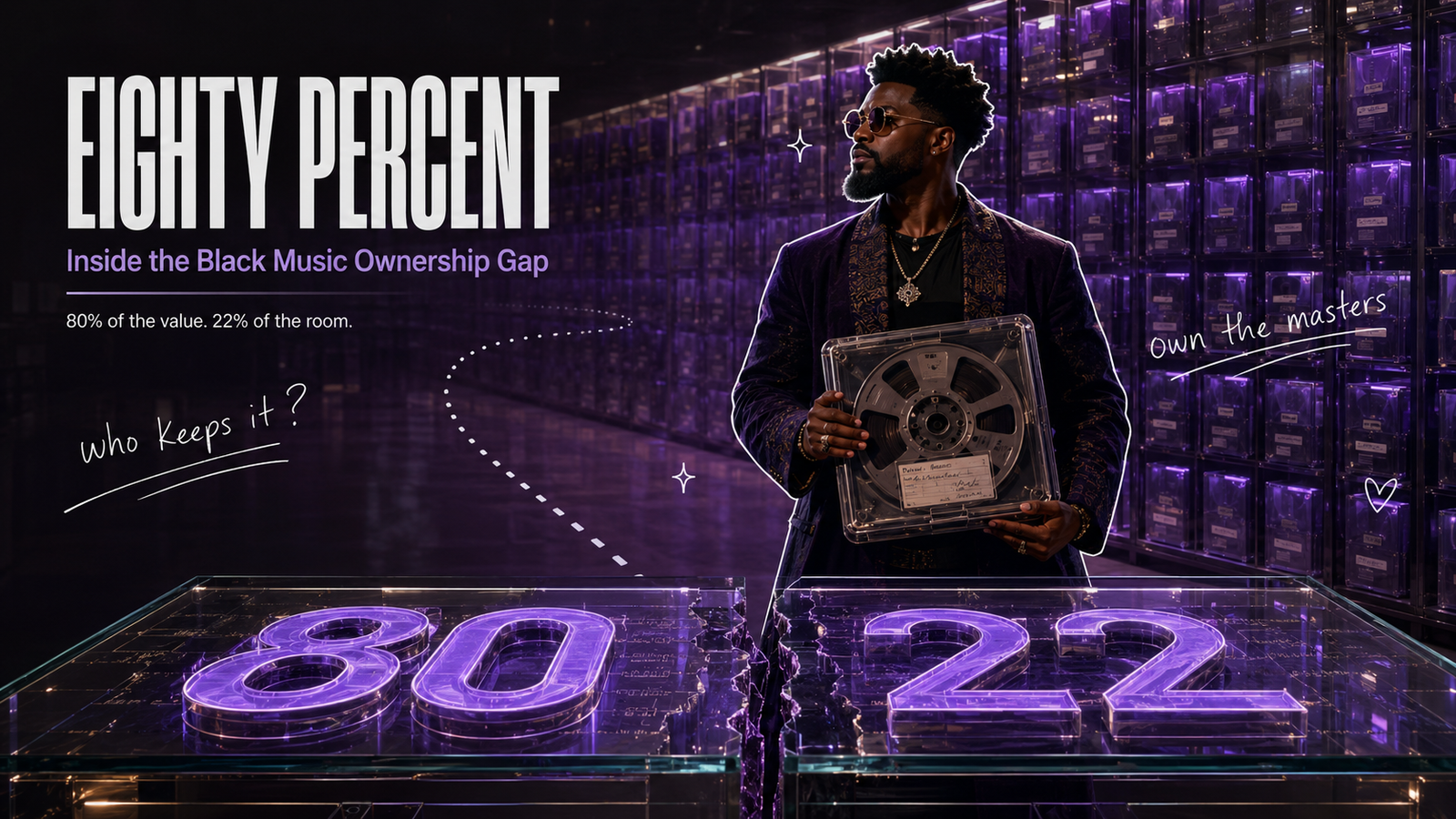
UK Music, the body representing Britain’s music industry, published research this year measuring Black music’s commercial contribution to the country. Between 1994 and 2023, that contribution came to £24.5 billion of a £30 billion recorded music market. Eighty percent.
Sit with that ratio for a second, because most reporting will not.
Four pounds in every five generated by one of the world’s two dominant music exporters — a country that sells its music the way France sells wine — came from Black music. Not as a niche within the market. As the market.
Then the same report gives you the second number. Just 22% of the industry’s workforce identifies as Black, Asian or minority ethnic, in a city where 46% of the population does. Black artists carry a documented 20% pay gap against their peers.
Eighty percent of the value. Twenty-two percent of the room.
There is a version of this article that treats those two figures as a tragedy and stops. I would rather treat them as an accounting problem, because that is what they are, and accounting problems have culprits.
The word “urban”
The industry had a word for this music for about thirty years. Urban. A geographic term applied to a sound that came from everywhere, doing the quiet work of keeping the thing describable without being ownable.
Nobody says “urban” now. The word got retired around 2020, in the season when a great many words got retired. What did not get retired was the arrangement underneath it — where the music is celebrated at the level of culture and negotiated at the level of catalogue, and those two conversations happen in different rooms with different people in them.
You can love something and still not pay for it. Industries do this constantly. It is not usually malice. It is just that admiration is free and equity is not.
What Lagos knows
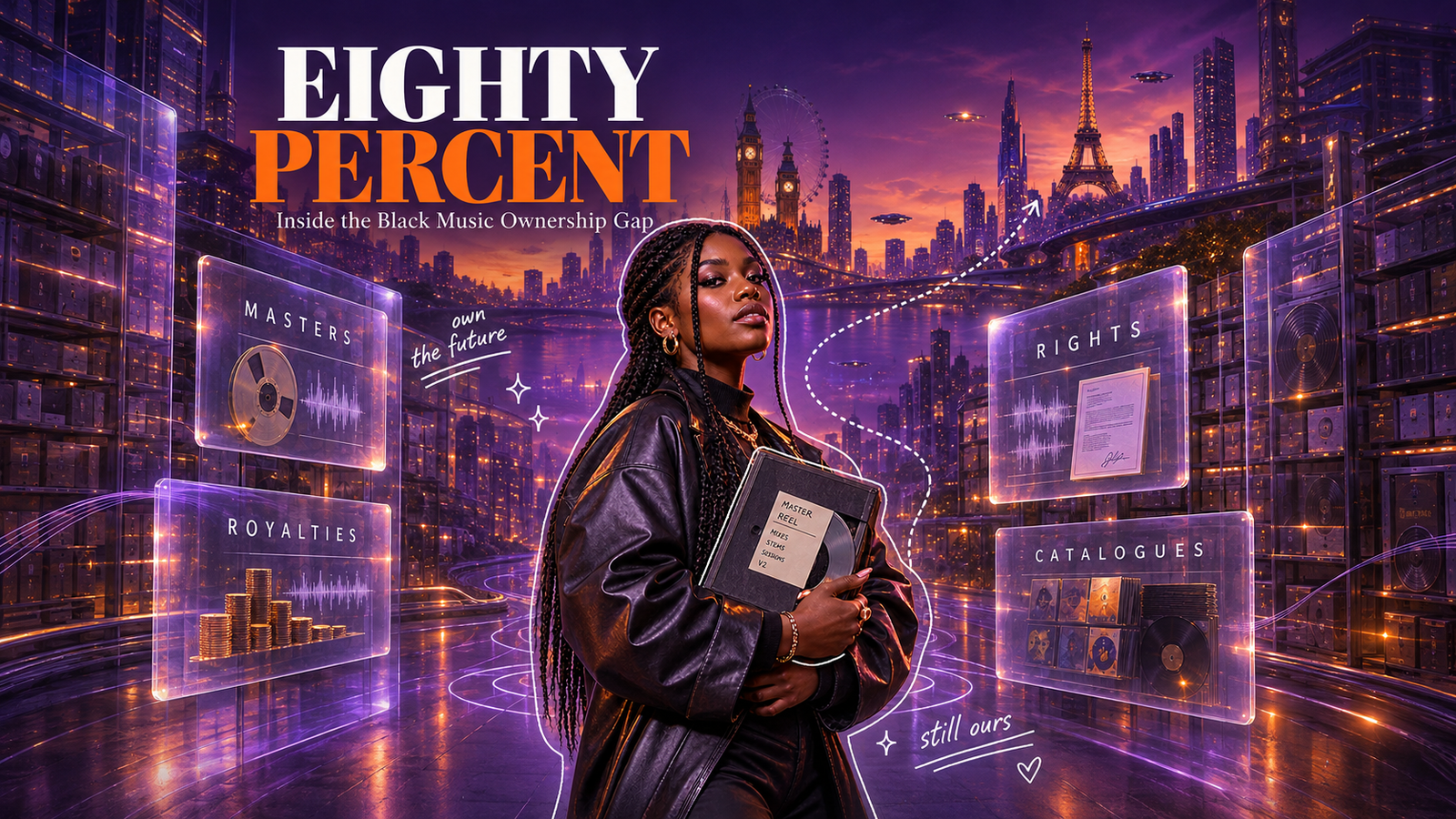
There is a stall I remember on a road in Lagos, one of those small operations selling music you could hear from three shops away. The man running it kept a ledger. Not a metaphor — an actual notebook, filled in by hand, tracking what moved and what did not.
He would have told you exactly which artist was selling that week. He could not have told you who owned the master. But the book was his. The count was his. Whatever the market did, he knew his own numbers, and nobody had to explain his business back to him.
Yoruba traders were running sophisticated ledger discipline for centuries before anyone showed up to name it economics. The instinct is old and it is specific: you can trade in someone else’s market, but you keep your own book.
Move that instinct three thousand miles north and it stops being obvious. The credentialed Black professional in London or Atlanta is asked, repeatedly, to translate themselves for rooms that have never had to translate anything. You learn the room’s language. You learn its ledger. And somewhere in the learning, you stop keeping your own.
That is the whole gap between eighty and twenty-two, expressed as a habit rather than a statistic.
The ownership gap repeats
Here is why this is not a British story.
Afro-Brazilian music built the sound that Brazil sells to the world, in a country where roughly half the population identifies as Black or mixed-race and the executive floors of its cultural institutions do not reflect that. French rap has been the commercial engine of the French music market for years, made largely by artists of African and Caribbean descent, signed to companies whose leadership does not resemble them. The American version needs no introduction; it has been written about for eighty years and changed slowly enough that the writing keeps being necessary.
Four countries. Four separate histories. Same arithmetic. The ownership gap is not a British problem.
When a pattern holds across that many unrelated systems, it stops being about any one industry’s failures and starts being about a shared default — one where Black creative output is treated less like a business and more like weather. Something that arrives, that everyone benefits from, that no one is expected to have built.

Weather has no owners. That is the useful thing about calling something weather.
The ordinary version
Strip the theory away and the Black music ownership gap reduces to something almost boring.
Ownership is whose name appears on the paper when the money moves.
That is it. Not visibility. Not influence. Not being respected, invited, sampled, celebrated, or thanked from a stage. Those are pleasant and they are not the same thing. A person can be the most-streamed artist in a territory and hold no position in the entity that collects.
Which means the fix is equally ordinary, and correspondingly difficult. Catalogue. Publishing splits. Board seats. Equity in the companies doing the distributing. Executive roles with hiring authority rather than advisory titles with a budget for a panel discussion. The unglamorous paperwork that decides where value settles once the applause stops.
The AfroNouveau reads a report like this and does not need it explained. What we have not always done is treat the twenty-two percent as the actionable number. Eighty percent is proof of what we make. Twenty-two percent is the address of what we do not yet hold.
The £24.5 billion was never in question. Somebody was always going to make that music.
The only open question was who would be holding the book when it sold.
All stats are verified and cited.
Nominations for the AfroNouveau 100 are open. We are looking for the people holding the book, not only the people on the stage.